Google launches Playground: when a game becomes a new no-code format
6 min read
Google Labs launched an experimental platform that turns a text description into a game that runs in the browser. What is actually available, what is still a promise, and why it matters to builders and creators in Saudi Arabia and the region, even though it is US-only for now.
On October 7, 2026, Google announced a new experiment from Google Labs called Playground: an experimental gaming platform where you describe a game in your own words and get a game that runs in the browser, without writing a single line of code. The tagline: "If you can think it, you can play it."
It is an eye-catching launch. But as someone who builds products, the question I care about is not "is this amazing?" It is three simpler ones: what is actually available today, what is still a promise, and where do we in Saudi Arabia and the region stand with an experiment that does not work outside the US yet?
What was announced?
According to Google's official blog post and the product page on the Labs site:
- Creation by conversation: you describe your game in a chat interface, start from a blank canvas, remix starter prompts, or use guided support, and then test the game right away.
- Editing by asking: you can ask to tweak the physics, rewrite the rules, change the characters, or overhaul the environment, without opening a game engine.
- Ready-made genres: the product page lists genres such as trivia, tower defense, and racing, alongside starting from scratch. According to TechCrunch and 9to5Google, you choose between 2D and 3D, and between single-player and multiplayer.
- Assets from your images: TechCrunch reports that you can upload visuals that the system turns into in-game assets matched to the game's art style.
- Publishing and sharing: keep a game private, share it with a link, or publish it to the platform's public Explore gallery. Select genres support leaderboards and multiplayer, with a player profile tied to Play Games.
- Moderation: Google says every published game goes through safety screening aligned with its Community Guidelines, plus user reporting.
The games are browser-based, so they can be played on a phone or a laptop without installing an app.
How does it work under the hood?
Google has not published a technical paper on Playground. The clearest detail came from a company spokesperson speaking to The Verge: the platform runs on Google's existing foundation models, Gemini, Nano Banana, and Lyria, paired with "a custom harness" refined through games and evaluations Google built internally.
How the work is split between those models, for example one handling game logic, another images, and the third music, has appeared in some secondary coverage. I could not find that split in Google's own post, so I treat it as a reasonable inference, not a confirmed fact.
What matters more to me than the model names is the word "harness." The value here is not one clever model. It is the layer that combines several models, constrains their output inside game templates that actually run, and then tests them. It is the same lesson we keep learning with coding agents: a model alone does not make a product; the product is what you build around it.
What is real and what is promised?
Available today: the platform itself, for users in the US aged 18 and over. According to the coverage, browsing and playing are free, while creation runs on a weekly token allowance: a limited allowance on the free tier and higher limits for subscribers to Google's paid plans, depending on the plan. The size of that allowance, and how many games it covers, has not been published.
Promised: an integration with Unity Spark, a new AI game-making tool from Unity with a real browser-based editor and artist-created assets from the Unity Asset Store. Google says Spark is currently in testing with a closed beta coming soon, and coverage says it will arrive in Playground later in 2026. There is no firm date and no final pricing model yet.
Unknown:
- When it will expand to other countries. TechCrunch reports that Google plans to expand, but there is no timeline and no country list.
- How well it supports Arabic, both in prompts and in the text inside games.
- How complex a game can really get before you hit the token limits or the limits of the models.
- The ownership terms for published games and the rights to use them outside the platform.
The word "experimental" is not a footnote. The product may change significantly or be discontinued, so it is not something to build a full business on right now.
Why does this matter for Saudi Arabia and the region?
Google is not alone here. TechCrunch notes that Roblox announced a prompt-based game creation feature in July, and The Verge points out that Meta has announced similar tools for its Horizon platform. When companies of this size move in the same direction, the signal is clear: the game is turning from an engineering project into a content format, like short video or template-based design.
Three practical readings from a builder's point of view:
1. Games are a format for teaching and marketing, not just entertainment. A teacher builds a trivia game for a lesson, a brand builds a short challenge for a campaign, a creator turns an episode idea into a game shared by link. The barrier is no longer writing code; it is the clarity of the idea and its rules.
2. The next question: who makes games in our language? As these platforms expand, Arabic-speaking audiences will look for games that reflect their language, culture, and humor. People who prepare their ideas now will move faster. But the platform is not available here today, and I do not recommend working around the geographic restriction; it is better to build on what is officially available to you.
3. The skill that transfers: designing rules. Whether you use Google's platform, another one, or an AI coding tool, the shared skill is writing a clear spec: what is the player's goal, what are the rules, when do they win or lose, and what brings them back for another round? You can practice that today without waiting for access.
What can you do today?
- Write a game brief of half a page for one idea: the goal, the rules, the ending, and the visual style. That is what you will need the moment the platform is available to you.
- If you are a developer, try the same idea with an AI coding tool and build a simple browser game, so you understand the limits of "a game from a description" first-hand.
- Join the Unity Spark waitlist if you are seriously interested in 3D games, keeping in mind that the regions for the closed beta have not been announced.
- Watch three things: expansion beyond the US, Arabic support, and the ownership terms for published games.
The bottom line
Playground is a serious signal that games are entering the "type what you want" era. But today it is a US-only experiment with a limited allowance, and its most ambitious part, the Unity integration, is still a promise. The real value for us right now is not in waiting, but in practicing the layer that stays the same however the tools change: a clear idea, written rules, and an audience you understand.
I will update this note if Google announces expansion to other countries or Arabic support, with a source that can be verified.
Sources
- Google's official blog post: Introducing Playground, October 7, 2026
- The Playground page on Google Labs
- Google Labs' post on X, October 7, 2026
- The Verge, with the Google spokesperson's statement, October 7, 2026
- TechCrunch on the platform and the weekly token system, October 7, 2026
- 9to5Google's report, October 7, 2026
- The Unity Spark page
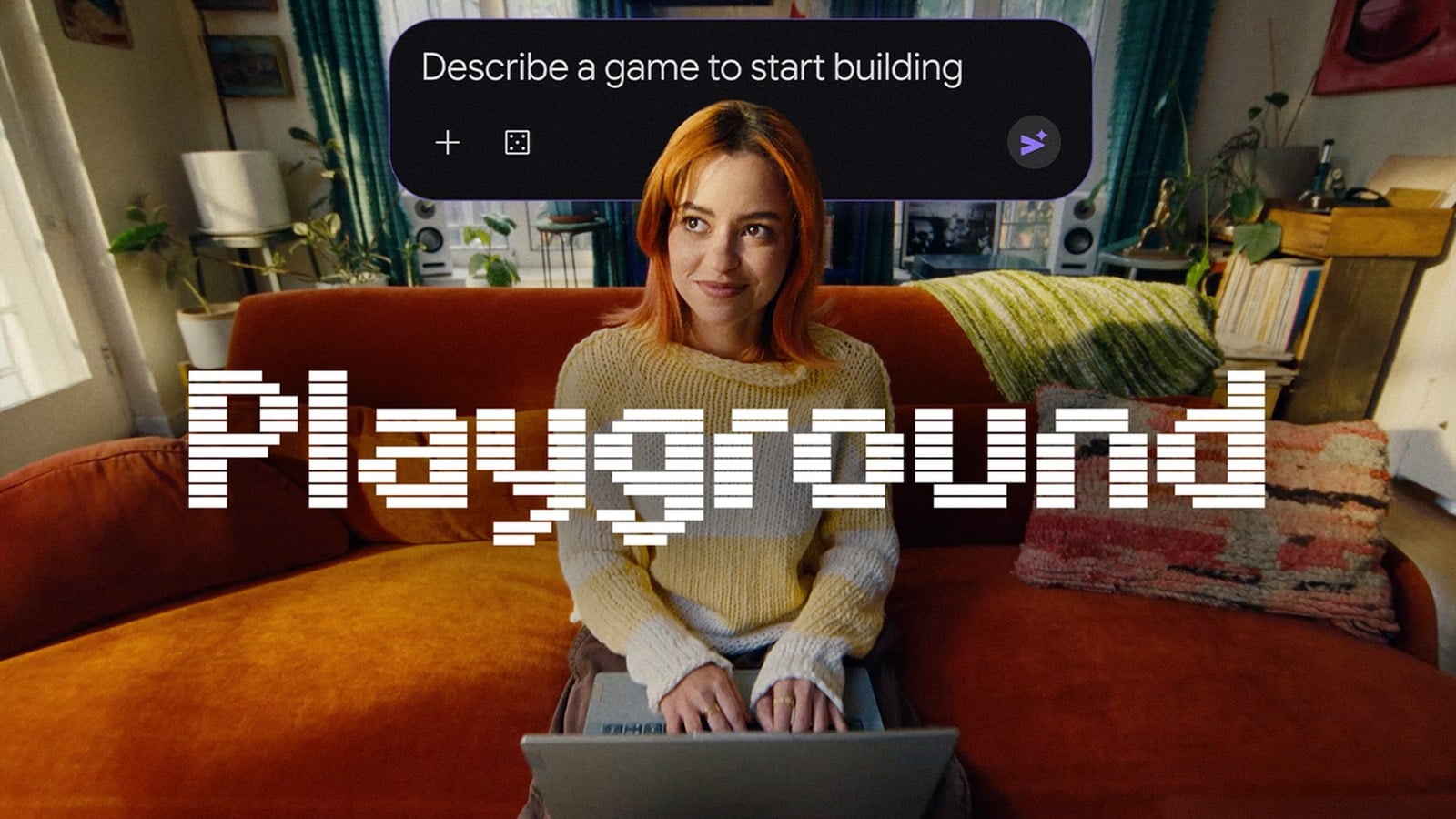
Cover image: official image from the Playground announcement on the Google blog.
Abdulrahman Alshehri — Building What's Next.